December 16, 2025 —The Philippines is known to have one of the longest, if not the longest Christmas seasons in the world.
Filipinos just know that when the “ber” months roll around - the first being September, Christmas is just around the corner! As soon as crooner Jose Mari Chan is heard on the airwaves singing “Christmas in Our Hearts,” as if on cue, malls all over the country light up, Santa Claus becomes ubiquitous (as well as the Three Kings), and carols are heard wherever one goes - including on public transportation.
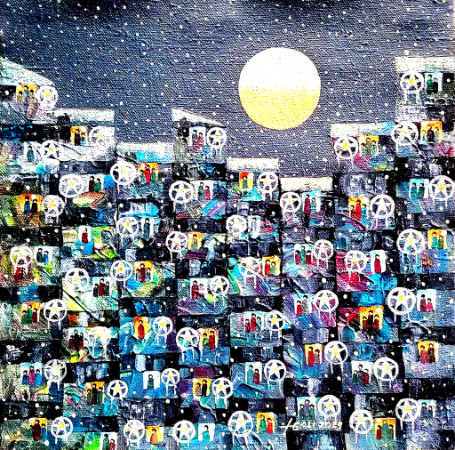 The Colors of Christmas, acrylic on canvas by Leo Gali.
Some phrases soon pepper everyday conversations, like “bonus,” “13th month pay,” “installment plan.” In North America, September is when cargo companies like LBC work overtime to accommodate the care packages Filipinos send home, or what we call the Balikbayan box, set to arrive by Christmas. The boxes contain treats for Christmas and New Year meals, like Spam, corned beef, Edam cheese and of course, chocolates - never mind that these tend to melt during the three-month passage. Not sending a care package when you are a Filipino abroad is quite a transgression!
Once December comes, the Grinch and other misanthropes will have no escape from the busyness, the smells of food, the cooking, the merrymaking. Windows suddenly fill with parol, bamboo and paper lanterns symbolizing the star that led the Three Wise Men to Bethlehem. Neighborhood children go from house to house, lustily belting out “Silent Night” and other carols, in hopes a homeowner would open the door and shower the group with coins or fresh peso bills. The week before Christmas Day housewives work overtime preparing traditional favorites like stuffed chicken relleno and meat rolls called embotido. Sites are sourced for the open-air roasting of a suckling pig - a duty for the men in the family.
This December, some homes will be visited with a pall of sorrow, including and especially those who were affected, directly or indirectly, by the April 26, 2025 tragedy at the Lapu-Lapu festival in Vancouver. The loved ones of 11 individuals who died will be feeling the full force of what they have lost - not just Filipinos, but also people of other nationalities who came to the festival curious, happy, eager to share in the celebration. Those who survived would still be living with the horror of that day.
Alex Reid is a teaching assistant, and a member of the Heiltsuk and Nisga’a nations with a Filipina stepmother. Two of his three sisters were at Lapu-Lapu Day; both were injured - one with serious physical injuries and the other with deep trauma. He described himself after the massacre as being like an egg that someone left frying on the stovetop while they took a shower.
“For me, it is so important that the victims continue to receive support,” Reid reflects. “We also need people to really understand the political and social context that brings about this type of violence. Attacks like the Lapu-Lapu massacre are driven by alienation, ignorance, hatred, division, hopelessness and other forms of anti-social tendencies; they do not develop in a vacuum.” He advocates for strong support of community organizations working to assist the victims and their families.
Ienelle delos Reyes is a Filipino student in Victoria and a member of Anakbayan who helped organize a vigil at the steps of the B.C. provincial legislature the evening of the tragedy. Asked to reflect seven months after the event, Delos Reyes says: “I still feel the heaviness of what occurred and the grief of the families who lost their loved ones, but primarily, as a community organizer, I feel there is a need to zoom out and recognize that what our community needs is not empty platitudes from politicians who want to make themselves look nice, but actual direct action that provides the immediate needs of people— as in survivor AJ Sico’s case. He and his family need support so they can physically and psychologically recover.”
Milo Canlas, a youth member of Bayan Canada who lives in Victoria, says: “The holidays coming up call us to hold justice and love even more closely in our hearts and to continue to advocate for those who were directly impacted. Any initiatives by the city or other government bodies to address what happened should centre the needs of the victims, their families, and community organizations that were supporting on the ground in the aftermath. Involving these voices in every step of the process will contribute to the long-term collective healing that is so needed at this time.”
Melissa Badua, president of the Bayanihan Cultural and Housing Society in Victoria, will be holding her son closer this Christmas. She says: “The tragedy stays with me in quiet ways, in the moments when my son is not with me and I feel really worried. Being a mother makes the loss feel so much more personal, even when it wasn’t my own family. It’s changed how I see safety, community, and what we owe each other.”
In Filipino families, a death is usually followed by nine days of prayers, or a novena. Friends and loved ones gather to light candles, pray the rosary and say intercessions, asking for mercy and light for the deceased. Each night of prayer ends with a big meal and stories. The loss is irreparable, but there is comfort in prayer and in togetherness.
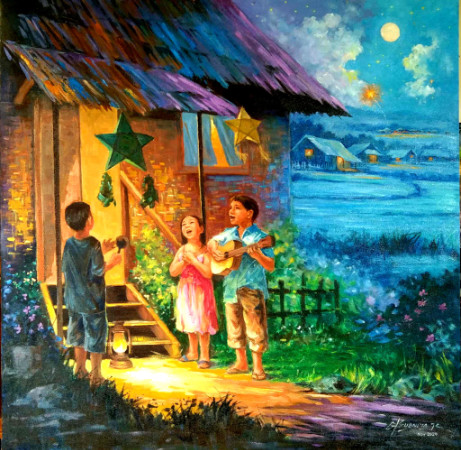 The Carolers, oil on canvas by Gerundio Buendia Jr.
On December 16, another nine-day Christmas tradition begins - what is commonly referred to as “Simbang Gabi,” or night mass. For nine successive nights or mornings, in anticipation of the birth of Christ, Filipinos go to church and pray: affirming their faith, offering the trials of the past year for healing, and expressing hopes and dreams for the coming year.
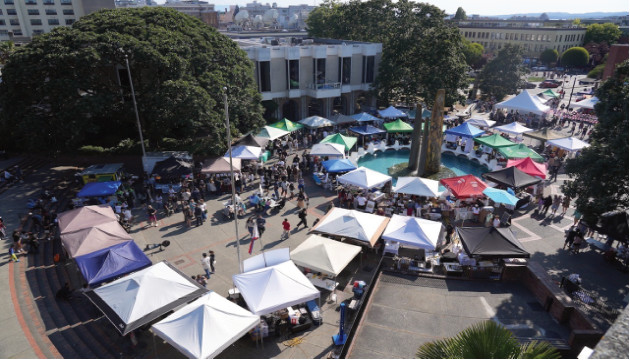
Outside the church, the spaces would be filled with stands and tables, all brightly lit, selling candles, rosaries and foods and treats - like steamed purple sticky rice called “puto bumbong;” rice cakes cushioned in banana leaves and baked in open fires called bibingka; waffles gleaming bright orange with a coat of margarine. The stands outside the church would not be that different from the stalls at the Lapu Lapu Day celebration, except those had the added popular feature of pork barbecue. There would be the same laughter, friends and neighbors greeting each other, even blasts of karaoke.
Nine days after a death, nine days before Christmas. Prayers of shock and sorrow after a death, prayers of supplication and hope at Christmas. For centuries this is what Filipinos have turned to in life’s great transitions - prayer.
The wounds from the April 26 massacre will take a long time to heal. But prayer assures us that not everything is in our hands, and that there is a loving presence that holds us close even in the greatest tragedies. That good comes out of the deepest suffering. And so, starting December 16, we will trek to church, and pray, and harder, for hope and healing at Christmas.
 About the author
Meyen (Marilynn) Quigley is a Filipino immigrant to Canada. She has a BA from the University of the Philippines in Iloilo, a Master's degree in intercultural administration from the School for International Training in Vermont, USA and a graduate certificate in professional communications management from Royal Roads University in Victoria. Meyen has worked as a teacher, a writer, and a program administrator in the Philippines, Sudan, the United States, Pakistan and Turkey, living in these countries with her husband Kevin, who worked on resettlement programs for refugees, and their children Gabriel and Megan. On their return to Canada she worked in social services and with the BC public service, and as a volunteer with the Filipino immigrant community in Victoria.