March 16, 2026 — Food has always played a huge part in Filipino culture. Filipinos share food generously with family and neighbours. We offer food to new friends. When there are disagreements, food can bridge our differences. To many Filipino families, the kitchen is the heart of the home, where dishes are lovingly prepared, to sustain us through our day, and to give comfort at the end of it. And when language fails, food speaks.
When the Lapu-Lapu Festival tragedy happened on April 26 last year, Filipino-Canadian chef TJ Conwi and entrepreneur Maj Yee understood right away that the scale of the tragedy needed all hands on deck. They asked themselves, “What can we do?” and “How can we help?” With their expertise and experience in the food industry, the answer came naturally.
Conwi is the owner of Ono Vancouver, a company that specializes in event catering and private dining. The company is also involved in community food programs through its social enterprise called ReRoot.
Yee, for her part, is owner of Goldilocks Bakeshop, a popular spot for Filipino cakes, pastries, and bread.
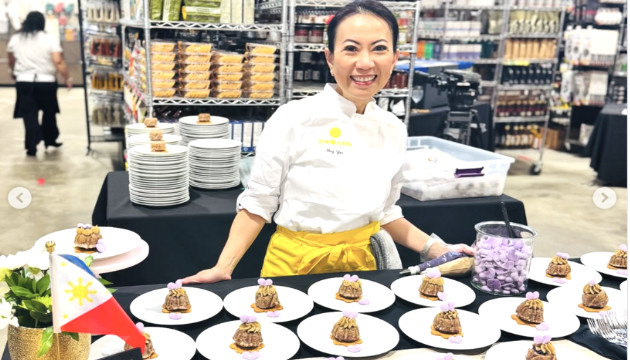
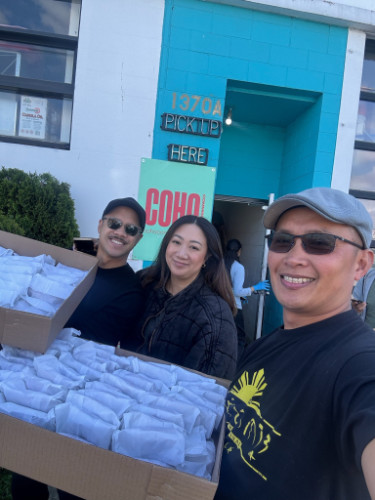 Chef TJ Conwi in front of the Coho Commissary where he prepared the meal train for the victims and survivors of the tragedy.
The day of the Lapu-Lapu Festival
Earlier that day, Conwi, together with his family, went to the Lapu-Lapu event to join in the festivities. He saw Yee at the Goldilocks Bakeshop booth and they talked for a bit. But Conwi left early because he still had a private function to prepare for.
Yee stayed at their booth the whole day and when they only had a few items left to sell, she decided to pack up and leave an hour earlier to avoid the rush when the festival ended. It was Yee’s first time to leave an event early but somehow, she felt strangely compelled to leave.
Yee got teary-eyed as she remembered how she narrowly missed the tragedy. She said “It hit too close to home. In fact, because April 26, the day before, was my dad's birthday… day after was his death anniversary in the Philippines… I have my dad's ashes in a little, little vial of my necklace and I wore that. And I always said to my mom, my dad was protecting me.”
When the car-ramming incident happened, Conwi remembered getting a call from a friend who told him what happened. He immediately started scrolling through social media to look for people that he knew were there. That’s how he came across a live feed of what was happening.
Yee said that she was driving home when she got a call from Conwi. “I was in total shock,” she recalled. But at the same time, Yee said they were already discussing what they can do to help and talked about providing food for the victims and their families.
Yee said she and Conwi agreed that “the last thing they’ll think about is their hunger. And it was going to be a long night.”
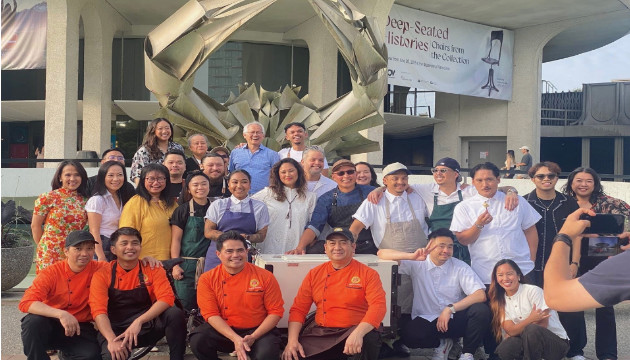 Chef TJ Conwi (centre, in dark glasses) and Maj Yee (second from left, standing) with the other Filipino chefs who participated in a fundraiser for Lapu-Lapu survivors and familie
How can we help?
After the initial shock from the first few hours of the tragedy, various Filipino individuals and groups have stepped up to fill the gaps in services.
Two of Conwi’sfriends, artist Mara Cortez and pastry chef Cyril de Ramos, had already started delivering food to the first responders who were dealing with all the people coming to the hospitals. Conwi thought, “How can we get to people that need support? How can we get meals to everybody so they don't have to think about it?”
During the Covid-19 pandemic, Conwi prepared and delivered 1,500 meals per week to vulnerable members of society. Although he is experienced in cooking meals for a large group, he knows he will be needing more support for the huge task at hand. So he asked for the help of the Filipino chefs of the Chef’s Table Society, of which he is a member of the board of directors.
“I knew that it was going to be tough because I knew that there was going to be a lot more people that we have to get to, but I knew that the meals are going to be there. And then, with the people that I know from the industry, all the Filipino chefs, it was just going to be pretty easy for me to get the meals and put it all together,” Conwi said.
As he was doing this, Conwi was also trying to get in touch with other victims and connect people who needed help with groups that they could talk to.
Yee, for her part, took it upon herself to connect with then Philippine Ambassador to Canada Maria Andrelita Austria and Consul General to Vancouver Gina Jamoralin with the City of Vancouver and the Vancouver Police Department. A non-Filipino friend of hers who works in public relations also helped her and Conwi connect with the hospitals and the Vancouver Coastal Health.
To be able to reach more victims, Conwi and Yee agreed to focus on the areas in Vancouver that are nearer to where they’re based. At the same time, Yee was also bringing packed lunches to Conwi because he had more capacity to deliver to the different places. By the end of three days, Conwi said they have delivered close to a thousand meals, through the help of volunteers, majority of whom are non-Filipinos. He said Uber also reached out to them and provided them with vouchers that they were able to use in transporting food to the victims and their families.
Food as a way of healing
Conwi noted that the meals he prepared after the tragedy are Filipino comfort food items.
“We were doing adobo, we're making lugaw (rice porridge), we're making, you name it, kare-kare (beef or oxtail in peanut sauce), sarciadong isda (fried fish in sauce), we're doing some of
our favourites… We had the goat caldereta (stewed goat meat), that's the kind of stuff that you want to eat during that time.” He was able to raise some money from GoFundMe and they used this to buy meat and other ingredients for the meals.
Conwi made it clear that they did not get any funding from United Way British Columbia for their meal train as they did not want to take away from the money that should be given to the victims and their families. But even with the funds that they raised through GoFundMe, and the seafood and meat donations from their supplier, he still had to dip into his pocket to cover some of the costs. He smiled as he said that “sometimes, the problem with not thinking twice sometimes… you don’t know sometimes the costs and how, what you’re getting into. But I always get paid in karma and so far, so good. It’s still coming.”
Yee said her suppliers also donated ingredients for baking, but for the most part, she also spent her own money. She said they gave food not just to the victims and their families, but also to the volunteers and first responders. She remembers bringing a few boxes of muffins and loaves to the members of the Vancouver police. “They were so happy because they don’t always receive a thank you from a community,” she said.
“You got me through some dark times.”
Yee said her parents taught them to always extend a hand to those in need. She’s imparting the same lesson to her sons. When she visited Adrian Jonez (AJ) Sico, who suffered serious injuries from the car-ramming attack, her youngest son went with her and he was the one who noticed that Sico had a small basketball with him. Seeing that Sico seems to love that sport, her son, who works for a sporting goods store, said he will see if their company can donate anything basketball-related to Sico to encourage him to get better. They had already bought Sico a pair of basketball shoes but the store gave him a second pair. Yee said, “AJ was so happy.”
One of her most memorable encounters with a Lapu-Lapu survivor was when she, together with Ambassador Austria and Consul General Jamoralin, visited Helgi Bjarnason, whose mother, Vicky, was one of the 11 who died in the car-ramming incident. Helgi, an occupational therapist, was also injured when he tried to pull his mom away from the vehicle, and underwent surgery.
Yee said that Bjarnason was so upbeat when he saw them. “He was so positive. And I could not believe he had smiles.” When they asked him why, he told them “How can anyone be sad during this time? I have the ambassador, I have the consul general and I have the owner of Goldilocks bringing me food. And everybody’s visiting me. And I’m satisfied.”
Conwi said that during the first days of their meal train, they were giving meals not just to the victims and their families but also to those who, although they suffered less serious injuries, were left incapacitated and were not able to leave the house. He shared that “even to this day, people will come up to me and say, ‘Hey listen, like just so you know, I was one of those people that got those meals, and you know, you got me through some dark times.’ And to be honest, like that in itself, it makes it worth it.”
Food as our Language of Love
Both Conwi and Yee believe that food is the language of Filipinos. Yee said “We help the way we know how. I grew up in the food industry and it’s by providing food that, I mean, it’s our language of love or if it's caring for one another and in our culture, food is how we… show care. And with food, that's how we gather in celebration, and it's also why we gather in grief.”
As of the end of 2025, Conwi said they were able to deliver up to 9,000 meals.
Conwi partnered recently with the Good Thief restaurant to hold a special “turo-turo” fundraiser
[Turo-turo is a Filipino dining style where food is prepared and displayed, and the customer points to the dishes they want to be served.] Their special guest was Lapu-Lapu victim AJ Sico. Conwi estimates that they were able to raise nearly $4,000 from the event. The proceeds from their turo-turo fundraiser was given directly to the families of AJ and Jendhel Sico, a cousin who perished in the tragedy. The total amount raised was $3,714 –and given to Jhosie Sico, AJ’s mother on March 11.
Yee is hopeful that the community will continue to extend help to the victims and their families. “I think compassion should never be, should never feel intrusive. And when the tragedy may have faded… it can fade away, but it doesn't end when the headline fades, right? And community shouldn't either”.

About the Author
Rowena Papasin is a broadcast journalist who has covered major beats and worked as executive producer of “TV Patrol”, ABS-CBN’s most watched news program in the Philippines, before moving to Canada. She was also a contributing reporter and Canada News Coordinator for The Filipino Channel (TFC). Last year, together with a group of former ABS-CBN colleagues who now live in Canada, they launched the digital news platform “Patrol Abroad” on YouTube where she continues to report on stories about the Filipino community, particularly in British Columbia. Based in Metro Vancouver, Papasin likes running, watching K-dramas and crafting.