April 16, 2026 - A woman leaves her family in the Philippines to start a new life abroad as an overseas Filipino worker (OFW). A student in Victoria who does not fit traditional gender roles and definitions struggles to belong.
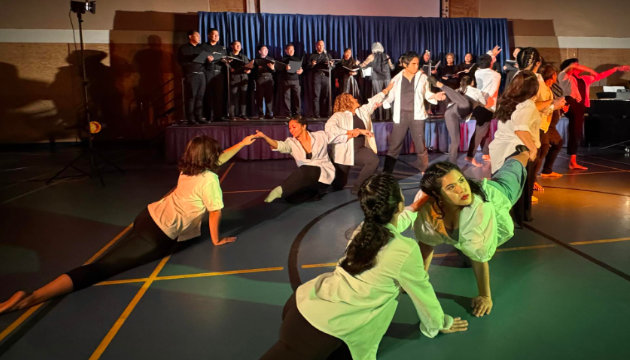
A man is assured that he does not have to be strong and macho; he can admit weakness and find support. A Filipino elder looks back on her life, and all the sacrifices she has had to make for her family to succeed. These are some of the stories that were told through song and dance in “Sabay Sakay sa Alon” (Riding the Tides Together), Suzanne (Sam) Penola`s love song to her Filipino community in Victoria, BC staged at the Selkirk Montessori School auditorium in December 2025.
A year punctuated by tragedy
2025 was not an easy year for Filipinos in BC. In April, the Lapu Lapu festival in Vancouver ended in carnage when an individual rammed his truck into the crowd of event-goers, killing 11 and injuring many more. In Victoria, the losses to the Filipino community include the deaths of two students enrolled at the University of Victoria (UVic). John Lucanas was on his last term at UVic, Albe Bantas had just completed her program in June. Janice Espinosa, another UVic student, lost her eight-year old daughter Dashia to leukemia in June.
These losses were the topic of conversation at dinner one evening between Sam and her parents, Jean and Geoffrey, and brother Sean.“We found ourselves reflecting on how unsettling it is that losing people to overwork, which is demanded for our survival, is barely surprising anymore. While the lives lost too soon were beyond our reach, we recognized a message and a reckoning that, as artists, we were obliged to speak on behalf of those still here.”
The conversation lit a spark in Sam and she conceived “Sabay Sakay sa Alon” to memorialize the losses of the past year, to name the many challenges that the Filipino migrant community faces, and also to celebrate the strength and fortitude of the community. “Alon” was also an opportunity for Sam to put into words, music and movement her own family’s journey as immigrants to Canada.
A Filipino family’s journey to Canada
Born in Iligan in Mindanao, Sam has had training and experience in ballet, music, and is also a passionate writer. She and her brother lived and breathed dance, music and drama as their parents were part of the Integrated Performing Arts Guild of the Mindanao State University- Iligan Institute of Technology. Arriving in Canada in 2017, the Penola family began volunteering with the Filipino Bayanihan Community and Housing Society (BCHS) in Victoria, eventually forming the core group for the Bayanihan Creative Collective (BCC) of the BCHS. Sam holds a bachelor’s degree in Political Science at UVic, and is now on a gap year pending enrollment in a law program.
Sam was in 11th grade when she arrived in Canada, completing high school at Belmont in Victoria. She got her first exposure to the tensions immigrants live with while in high school. “I felt different,” she says. Her Caucasian classmates expected her to disappear into the group of Filipino students on campus, but she did not quite fit in with the Filipinos either, some of whom were born in Canada or had experiences in the Philippines very different from hers. Her facility with English put her in an in-between space that was not easy to negotiate. In those early years, she saw her parents juggle two or three jobs to keep the family afloat. Sam found a more diverse community at UVic, but also got exposed to what young migrants struggle with, including struggles with ethnic and gender identity and mental health.
An inclusive community rides the wave
Thus, in “Sabay Sakay sa Alon,” Sam herself and Shane Baliog acted out the confusion and ache of not quite belonging with one’s age and gender group. Sam’s parents Jean and Geoffrey reenacted the painful separation that is seen daily in thousands of Filipino homes, when a spouse leaves for abroad. Jean continued on to interpret through dance the very hard work, the loneliness and the longing of the OFW for home. Francis Matheu, together with Geoffrey and Sean, and Arnel Bongcasan expressed the heaviness of societal expectations of men to not show weakness, and Sam and Kaye Abellana danced the longing of queer youth to be safe and understood. Cristeta Araquel, who is a member of the Filipino seniors’ community in Victoria, looked on as the various transitions in her life were danced by Richenda Garcia and Jean Penola to the words of “Both Sides Now.” The wisdom of elders and caring for them was an oft-repeated theme, with Clarissa Mijares dancing the role of the dutiful eldest child.
Marjorie Venus Baliog, Janice Concepcion, and Razie Mae Lauzon rounded out the dance group. The choir, made up of Canadian Filipinos and under the direction of Ruby Tiburcio, was accompanied by Filbert Zhang on the flute and Daniel Torres on the piano. Officers and board members of the BCHS and the Victoria Filipino Canadian Association (VFCA) provided moral and logistics support.
When asked about the title of the show, Sam says, “It came from our inclination to water as a people. Water has become symbolic to Filipino culture. It is reflective of our spirituality, our adaptability, our way of life, and the strength that is found in our calmness and gentleness much like the characteristics of waves.”
The show did not simply name the challenges that the migrant community faces. The naming is important, especially when it comes to recognizing situations as mental health challenges, because “…(we have) a culture where expressing mental distress is perceived as a sign of personal failure or seeking attention (papansin). In stigmatizing it, we have lost far too many Filipinos, children and adults alike, and many continue to suffer in silence,” the narrator says in the introduction to the show.
The show also highlighted the strengths of the Filipino community. “Migration is a double-edged sword,” the narrator in the show recounts, “for even though most of us would not choose to leave our homes, we at least know that there are always kababayan we can turn to no matter which corner of the world we land in…. There will always be pieces of home– a community that rises and falls with the waves. Kasama ka namin sa pag angat at pagbagsak ng alon.”
“Alon” had a particularly strong message to migrant youth: “….. the most common misconceptions about the youth are that they are lazy or entitled, that they do not value tradition, and that they are naive about the realities of the world. But the truth is, they are the ones most affected by everything we leave in this world.”
The show concluded with a resolve: “We must create spaces where seeking help is seen as courage, where mental health is treated as a right, and where every Filipino—regardless of circumstance—can be seen, heard, and supported in their struggle.” “Sabay Sakay sa Alon,” does exactly that: it holds space for different members of the Filipino community and acts as a creative repository of their experiences.